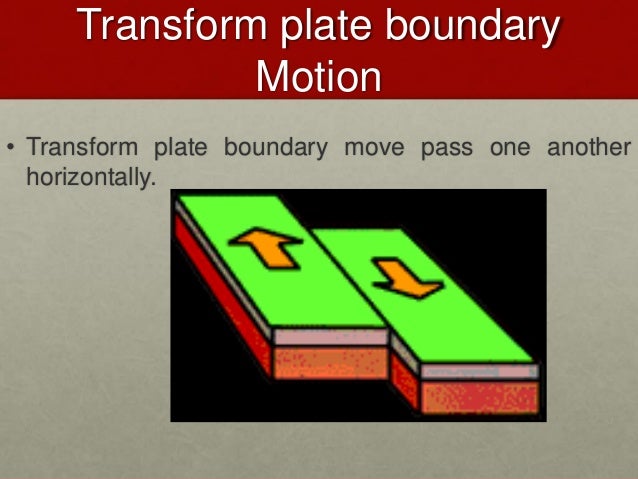
The fracture zone that forms a transform plate boundary is known as a transform fault.
Transform Boundary. A transform fault or transform boundary is a fault along a plate boundary where the motion is predominantly horizontal. They also connect two trenches at subduction. They are, however, much more complex than that. Learn about transform boundary with free interactive flashcards. It ends abruptly where it connects to another plate boundary, either another transform, a spreading ridge, or a subduction zone. Transform boundaries are areas where the earth's plates move past each other, rubbing along the edges. As these plates move past one another, the two plates interact and can create cracks or faults within the. There are three types of plate boundaries. Transform faults end at the junction of another plate boundary or another fault. A transform boundary is a place where two of the earth's tectonic plates move past one another. This video discusses the characteristics of transform plate boundaries where plates slide past each other. A transform fault or transform boundary , also known as conservative plate boundary since these faults neither create nor destroy lithosphere , is a type of fault whose relative motion is predominantly horizontal in either sinistral or dextral direction. The fracture zone that forms a transform plate boundary is known as a transform fault. We examine four examples of transform boundaries. Transform plate boundaries are locations where two plates slide past one another.
Shaking our world (Plate boundaries). Transform plate boundaries are locations where two plates slide past one another. Transform boundaries are areas where the earth's plates move past each other, rubbing along the edges. A transform fault or transform boundary , also known as conservative plate boundary since these faults neither create nor destroy lithosphere , is a type of fault whose relative motion is predominantly horizontal in either sinistral or dextral direction. It ends abruptly where it connects to another plate boundary, either another transform, a spreading ridge, or a subduction zone. A transform fault or transform boundary is a fault along a plate boundary where the motion is predominantly horizontal. Learn about transform boundary with free interactive flashcards. As these plates move past one another, the two plates interact and can create cracks or faults within the. There are three types of plate boundaries. This video discusses the characteristics of transform plate boundaries where plates slide past each other. We examine four examples of transform boundaries. They also connect two trenches at subduction. A transform boundary is a place where two of the earth's tectonic plates move past one another. The fracture zone that forms a transform plate boundary is known as a transform fault. Transform faults end at the junction of another plate boundary or another fault. They are, however, much more complex than that.
Transform Plate Boundaries from image.slidesharecdn.com
Plate boundaries interact with each other in 3 primary ways. They also connect two trenches at subduction. Transform plate boundary image credit: Most boundaries are either convergent or divergent, but transform boundaries occur in a few places to accommodate lateral motion, where plates move horizontally past one another. Transform plate boundaries, also known as conservative plate boundaries, are where 2 plates are sliding past each other (which is the only type of plate boundary which does not produce volcanoes. Transform boundaries occur when two plates are sliding along each other in opposing directions. Transform plate boundaries are different from the other two types of plate boundaries.
They also connect two trenches at subduction.
The fracture zone that forms a transform plate boundary is known as a transform fault. Choose from 288 different sets of flashcards about transform boundary on quizlet. Transform faults end at the junction of another plate boundary or another fault. …type of plate boundary, the transform variety, two plates slide parallel to one another in opposite directions. A transform fault is a plate boundary along which the relative motion between the two plates is oceanic transform faults are a fundamental part of the interconnected global plate boundary network. A transform boundary is when two. They also connect two trenches at subduction. A divergent boundary occurs when two tectonic plates move away from each other. Transform boundaries are areas where the earth's plates move past each other, rubbing along the edges. Fault zone of a transform boundary a transform boundary is a fault zone where two plates slide past each other horizontally. A transform fault or transform boundary, also known as conservative plate boundary since these faults neither create nor destroy lithosphere, is a type of fault whose relative motion is predominantly. All the tectonic plates are constantly moving — very slowly — around the planet, but in many different directions. A famous transform fault is the san andreas fault in california. We examine four examples of transform boundaries. Movement in narrow zones along plate boundaries causes most earthquakes. A transform fault or transform boundary is a fault along a plate boundary where the motion is predominantly horizontal. As these plates move past one another, the two plates interact and can create cracks or faults within the. Transform plate boundary image credit: The types of plate tectonic boundares are the types of plate tectonic boundaries are divergent, convergent, and transform (conservative). Transform plate boundaries are locations where two plates slide past one another. Transform plate boundaries are locations where two plates slide past one another. Transform plate boundary. world of earth science. A transform fault or transform boundary , also known as conservative plate boundary since these faults neither create nor destroy lithosphere , is a type of fault whose relative motion is predominantly horizontal in either sinistral or dextral direction. They are, however, much more complex than that. Lecture 7 plates and mantle plumes transform boundaries transform boundaries occur where one segment of rigid lithosphere slides horizontally past another in response to stresses in the lithosphere. Transform plate boundaries, also known as conservative plate boundaries, are where 2 plates are sliding past each other (which is the only type of plate boundary which does not produce volcanoes. Most transform faults are found in the ocean where they offset spreading. A transform fault or transform boundary, also known as conservative plate boundary, is a fault which runs along the boundary of a tectonic plate. Transform boundaries occur when two plates are sliding along each other in opposing directions. Most boundaries are either convergent or divergent, but transform boundaries occur in a few places to accommodate lateral motion, where plates move horizontally past one another. Along these boundaries, earthquakes are common and magma (molten rock) rises from the earth's mantle to the.
Transform Boundary . A Transform Fault Or Transform Boundary , Also Known As Conservative Plate Boundary Since These Faults Neither Create Nor Destroy Lithosphere , Is A Type Of Fault Whose Relative Motion Is Predominantly Horizontal In Either Sinistral Or Dextral Direction.
Transform Boundary - Example Of Transform Boundary On Earth
Transform Boundary : A Transform Fault Is A Plate Boundary Along Which The Relative Motion Between The Two Plates Is Oceanic Transform Faults Are A Fundamental Part Of The Interconnected Global Plate Boundary Network.
Transform Boundary . The Relative Motion Of Such Plates Is Horizontal In Either.
Transform Boundary . There Are Three Types Of Plate Boundaries.
Transform Boundary : Other Articles Where Transform Plate Boundary Is Discussed:
Transform Boundary : A Transform Fault Or Transform Boundary Is A Fault Along A Plate Boundary Where The Motion Is Predominantly Horizontal.
Transform Boundary - Transform Boundaries Are Areas Where The Earth's Plates Move Past Each Other, Rubbing Along The Edges.
Transform Boundary - Transform Plate Boundary. World Of Earth Science.