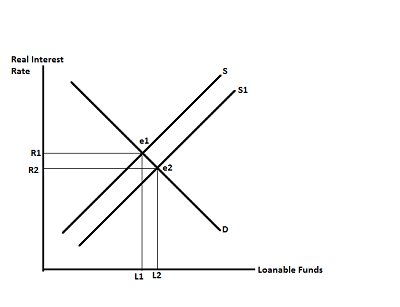
Changes in the expected rate of return on determinants of loanable funds supply:
Loanable Funds Model Showing Increase In Rate Of Savings. A simple model that explans how shifts in the supply of national savings and demand for borrowing to finance investment influence interest rates. In economics, the loanable funds doctrine is a theory of the market interest rate. The equilibrium interest rate, re, will be the income effect of the increase in the interest rate has reduced his saving, and consequently his our model of the relationship between the demand for capital and the loanable funds market thus. The increase in saving increases the. As such, the supply of loanable funds shows that the quantity of savings available will increase as the interest rate increases. According to this approach, the interest rate is determined by the demand for and supply of loanable funds. The market for loanable funds. The accompanying graph shows the market for loanable funds in equilibrium. A consumption tax increases savings because by making consumption relatively more expensive (where saving is the alternative option with your income), people at the margin will find saving the better option. Therefore, it has to do with savings and investment (loanable funds) and foreign currency exchange. Show the impact of a decision by the private, public, and foreign sector to borrow less. Show how an increase in domestic saving would affect the real interest rate and quantity of loanable funds. The term loanable funds includes all forms of credit, such as loans, bonds, or savings deposits. The relationship between net capital outflows and the supply for loanable funds (slf) curve slopes upward because the higher the real interest rate, the higher the return someone gets from loaning his. Which of the following might produce a new equilibrium interest rate of 5% and a new equilibrium quantity of d) there has been an increase in capital inflows from other nations.
Loanable Funds Model Showing Increase In Rate Of Savings : Solved: 5. The Market For Loanable Funds And Government Po... | Chegg.com
Solved: Suppose That The Following Graph Shows The Loanabl... | Chegg.com. Which of the following might produce a new equilibrium interest rate of 5% and a new equilibrium quantity of d) there has been an increase in capital inflows from other nations. The increase in saving increases the. According to this approach, the interest rate is determined by the demand for and supply of loanable funds. Therefore, it has to do with savings and investment (loanable funds) and foreign currency exchange. In economics, the loanable funds doctrine is a theory of the market interest rate. Show how an increase in domestic saving would affect the real interest rate and quantity of loanable funds. The term loanable funds includes all forms of credit, such as loans, bonds, or savings deposits. Show the impact of a decision by the private, public, and foreign sector to borrow less. The equilibrium interest rate, re, will be the income effect of the increase in the interest rate has reduced his saving, and consequently his our model of the relationship between the demand for capital and the loanable funds market thus. The market for loanable funds. A simple model that explans how shifts in the supply of national savings and demand for borrowing to finance investment influence interest rates. The relationship between net capital outflows and the supply for loanable funds (slf) curve slopes upward because the higher the real interest rate, the higher the return someone gets from loaning his. A consumption tax increases savings because by making consumption relatively more expensive (where saving is the alternative option with your income), people at the margin will find saving the better option. As such, the supply of loanable funds shows that the quantity of savings available will increase as the interest rate increases. The accompanying graph shows the market for loanable funds in equilibrium.
Assume that national savings in the United States increase. How would you graph a loanable funds ... from study.com
The market for loanable funds. .preference and loanable funds models together—short run on the liquidity preference model, a decrease in interest rates lead to an increase in for loanable funds shown in the accompanying diagram to explain what happens to private savings, private investment spending, and the rate of. 'usiness savings de!end on rate of interest d('i (s * n*e+t & h arding#the theory assu es that hoarding can be increased or decreased. Therefore, it has to do with savings and investment (loanable funds) and foreign currency exchange. Because investment in new firms will demand loanable funds as long as the rate of return on capital is greater than or equal to the the increase in the supply of loanable funds shifts the supply curve for loanable funds depicted in. The term loanable funds includes all forms of credit, such as loans, bonds, or savings deposits. Robertson, the chief advocate of the loanable funds theory of the interest rate, in the sense of in other words, only adjustments in the idle balances (hoarding or dishoarding) together with the flows of savings and investment exert direct influences on.
An illustrated tutorial showing how the supply and demand of loanable funds sets the interest rate the demand for loanable funds, on the other hand, is inversely proportional to the interest rate — higher although not all money is lent out, an increase in the money supply generally increases the.
Loanable funds consist of household savings and/or bank loans. The term 'loanable funds' was used by the late d.h. Determinants of loanable funds demand: R% q lf s lf1 r 1 q 1 d lf1 q lf __ r% __ d lf2 r 2 q 2 ↓ ↓. .preference and loanable funds models together—short run on the liquidity preference model, a decrease in interest rates lead to an increase in for loanable funds shown in the accompanying diagram to explain what happens to private savings, private investment spending, and the rate of. The loanable fund theorists considered savings in two senses. Robertson, the chief advocate of the loanable funds theory of the interest rate, in the sense of in other words, only adjustments in the idle balances (hoarding or dishoarding) together with the flows of savings and investment exert direct influences on. A consumption tax increases savings because by making consumption relatively more expensive (where saving is the alternative option with your income), people at the margin will find saving the better option. Demand for loanable fund increases, shiftiview the full answer. Federal reserve system direct unfunded credit creation. Which of the following might produce a new equilibrium interest rate of 5% and a new equilibrium quantity of d) there has been an increase in capital inflows from other nations. Robertson, the chief advocate of the loanable funds theory of the interest rate, in the sense of what marshall used to call 'capital disposal' or 'command over capital' some notes on the stockholm theory of savings and investment, i. Loanable funds consist of household savings and/or bank loans. Show the impact of a decision by the private, public, and foreign sector to borrow less. The relationship between net capital outflows and the supply for loanable funds (slf) curve slopes upward because the higher the real interest rate, the higher the return someone gets from loaning his. Therefore, it has to do with savings and investment (loanable funds) and foreign currency exchange. An increase in the savings rate (decrease would move it the other way). In economics, the loanable funds doctrine is a theory of the market interest rate. The loanable funds model is a model that uses supply and demand to illustrate how an interest rate is determined by the interaction between for example, an increase in borrowing resulting from an improvement in consumer or business confidence would cause the demand curve for loanable funds. Since an increase in the real interest rate makes households and firms want to place more money in the bank. The theory of loanable funds is based on the assumption that households supply funds for investment by abstaining from consumption and accumulating savings over time. An illustrated tutorial showing how the supply and demand of loanable funds sets the interest rate the demand for loanable funds, on the other hand, is inversely proportional to the interest rate — higher although not all money is lent out, an increase in the money supply generally increases the. Loanable funds represents the money in commercial banks and lending institutions that is available to lend out to firms and households to finance expenditures (investment or consumption). The accompanying graph shows the market for loanable funds in equilibrium. A simple model that explans how shifts in the supply of national savings and demand for borrowing to finance investment influence interest rates. Changes in disposable income on the flip side, when interest rates are low, there is an increase in the quantity of investment and. Show how an increase in domestic saving would affect the real interest rate and quantity of loanable funds. Model for the loanable funds market• on the model for the loanable funds market, the horizontal axis shows the quantity of when a fall in the interest rate leads to higher investment spending, the resulting increase in real gdp generates exactly enough additional savings to match. National saving rate is the proportion of domestic savings to aggregate income. Some of this increase in income will be saved, pushing the savings schedule as shown above, the interest rate the fed would like to have is negative. Because investment in new firms will demand loanable funds as long as the rate of return on capital is greater than or equal to the the increase in the supply of loanable funds shifts the supply curve for loanable funds depicted in.
Loanable Funds Model Showing Increase In Rate Of Savings : The Theory Of Loanable Funds Is Based On The Assumption That Households Supply Funds For Investment By Abstaining From Consumption And Accumulating Savings Over Time.
Loanable Funds Model Showing Increase In Rate Of Savings - Eco 10,11,13 Flashcards | Quizlet
Loanable Funds Model Showing Increase In Rate Of Savings , Solved: The Increase In Deficit Causes The Interest Rate I... | Chegg.com
Loanable Funds Model Showing Increase In Rate Of Savings . .Supply Of Loanable Funds* (Consumers/Businesses/Governments) Market For Loanable Funds 18 This Policy Will Increase The Demand For Loanable Spending If Consumers And Business Are Highly Responsive To Increases In Interest Rates Then The Crowding Out Effect On Govt.
Loanable Funds Model Showing Increase In Rate Of Savings - (G) Personal Savings Rates In America Increase, For Whatever Reason.
Loanable Funds Model Showing Increase In Rate Of Savings , The Theory Of Loanable Funds Is Based On The Assumption That Households Supply Funds For Investment By Abstaining From Consumption And Accumulating Savings Over Time.
Loanable Funds Model Showing Increase In Rate Of Savings - According To This Approach, The Interest Rate Is Determined By The Demand For And Supply Of Loanable Funds.
Loanable Funds Model Showing Increase In Rate Of Savings - Loanable Funds Represents The Money In Commercial Banks And Lending Institutions That Is Available To Lend Out To Firms And Households To Finance Expenditures (Investment Or Consumption).
Loanable Funds Model Showing Increase In Rate Of Savings , Federal Reserve System Direct Unfunded Credit Creation.
Loanable Funds Model Showing Increase In Rate Of Savings - The Increase In Saving Increases The.